They were 11 Clones

Checkout my latest game for #onegameamonth project: They were 11 Clones! It’s a 3D top-down twin-stick shooter with a twist: you can clone yourself (up to 11 clones!) & make scores by depositing the clones.
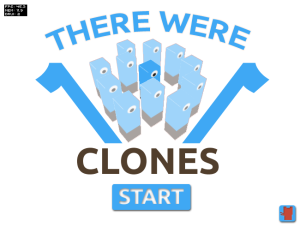
they were 11 clones

The game is developed using Ash Framework, Starling framework and Away3D 4. You can check the source code at GitHub. Feel free to fork & modify the project as you like ;-)

Motivation

I love twin-stick shooter. I’ve played mini gore, Age of Zombies, Guerilla Bob, & many more, but my favorite is still SisPri Gauntlet. It has chibi characters, big map & levels (instead of open arena), bullet hell, and epic big boss battles.

I’ve always wanted to make one with 3D character but back then Flash didn’t have GPU-acceleration. Now we have Stage3D but there aren’t many top-down shooters yet, so I decided to make one.

What’s with the name? The title was inspired by the movie They were elevenWhy eleven, why not 10 or 8? because the game development was started on November :-)

I love Ash Framework

This is my second attempt with Ash Framework & I’m really into this framework. It takes time to get used to entity-component-system thingy, but once you get it, your game architecture will be cleaner & easier to manage. Coding will be much fun.

So I’ve decided to convert all my existed game prototypes into this framework. And just two days before I wrote this post, Rob Bateman from Away3D has also re-written his Inawayders using Ash Framework. That’s a good sign.

Finishing is hard

This game was originally made for GitHub Game Off last Nov 2012. Unfortunately, I didn’t make it on time. Luckily, I got my seconds chance through Indie Goodbye. I keep on polishing the game & submit it as my January onegameamonth project. Even the game is still not completed 100% yet (no sound, only blocky character, no character animations, no shiny FX) but I’ve decided to publish it anyway.

It takes discipline and lots of motivation to finish. That’s why I join onegameamonth project as an exercise & also bought McFunkypants’ GameJam Survival Guide book. It’s a really good book on how to finish your game. I totally recommend to read it even if you’re not joining any game jam soon ;-)

So what’s next?

onegameamonth for February and playing with Ash Framework JavaScript. Stay tuned ;-)

Experiment with Ash Framework

Months ago, I was experimenting with HTML5 game development. Since it’s a fresh start, I thought, why not start with a better game architecture? So I made an experiment with Backbone.js, one of the famous JavaScript frameworks, but I don’t think MVC/MV* would fit for game development. That’s when I found  entity-component based framework.

There are many famous game engines which already use this kind of framework like Unity3D or XNA. I found some on the list of JavaScript game engines but I was surprised when I found even more for ActionScript 3:

I tried to learn more about this and found a very good article by Richard Lord. He wrote a good explanation on what entity-component framework is and why it ‘s better for game development. He also developed Ash framework for ActionScript 3. It includes a simple Asteroid game, but once I’ve read the source code, I was immediately sold to this framework.

Ash framework is simple and minimalist. It only includes the basic components which means you can combine it with your favorite 2D/3D, game or physics engines, and can be easily ported to JavaScript or Haxe (someone have already done this. See HashDS and Ash-Haxe).

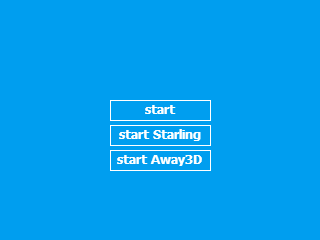
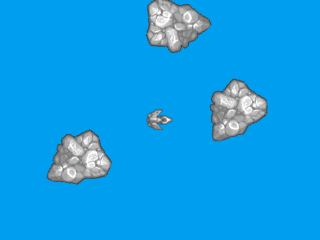
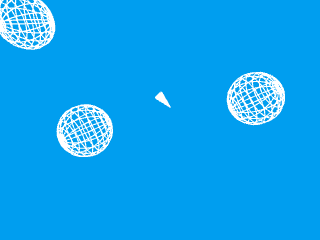
So I made an experiment, extending the Asteroid game so it can support Native Flash, Starling, and Away3D. All renderers in one game!

Checkout the demo at http://abiyasa.com/lab/away3d/ashteroids/

Using Ash framework, it is easy to switch between renderers. The game logic and other components stay the same; the only difference is which renderer system is being used. Check out the GitHub page for more info about this ;-)

It’s funny how I started with HTML5 game development but end up with a better ActionScript framework :-)

Bonus: Some other articles on Entity-component framework:

Playing with WebGL & Three.js

I’ve been playing around with JavaScript lately: trying BackboneJS, developing a small project popup help, and reading good articles about ‘modern’ way to use JavaScript.

I still think ActionScript is better but there is one thing that I love most from JavaScript:

No compiling is needed!

I really really love this. You type your code (using Adobe Brackets or Notepad++), refresh your browser, and you see the result. That’s it :-) This allows faster workflow, you can easily try this and that and see the result immediately. With cool debugging tools from Google Chrome or Firebug on Firefox, you can check if there’s something wrong with your code on the browser.

Anyway, I’m currently trying Three.js for WebGL and so far I like it. The setup is easy, just like Away3D. Totally recommended if you’re familiar with Away3D or other 3D engine. Three.js also includes some python scripts for converting OBJ models into its on JSON-based model.

You can click the image below for my Milk Carton Boy model in WebGL using Three.js. Unfortunately, it only works if your browser support WebGL.

The source code is available on GitHub ;-)

Pilot Cat: Game Teaser on Android

Teaser for my next game, this time it’s on my Samsung Galaxy S

Pilot Cat Teaser on Android

Pilot Cat Teaser on Android

It runs pretty well, around 30/30 FPS :-)

I didn’t install the Adobe AIR 3.2 Release Candidate on my phone since the released version will be out soon. So I made the APK file with Air captive runtime, which means the package includes the AIR runtime inside your app.

I use the latest Away3D 4.0 but I had problem during compilation. I got a strange error message with depthAndStencil. Luckily, someone had the same problem with me and post the solution on Away3D forum.

Stay tune!